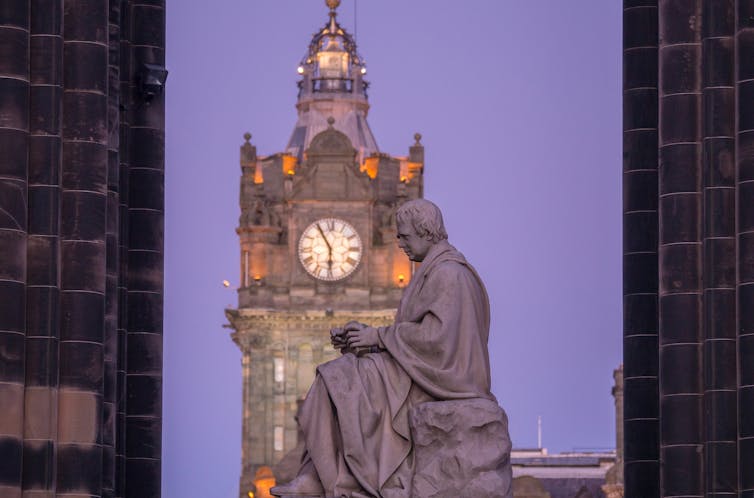
Wander through Edinburgh and you will find glimpses of Scotland’s most famous novelist, Walter Scott, everywhere: pubs named after characters or places in his books, his walking cane and slippers in The Writers’ Museum, and snippets of his work adorning the walkways of Waverley train station – named after his first and most famous novel. And just outside, towering over Princes Street Gardens, his statue stands beneath an elaborate monument affectionately dubbed the “Gothic Rocket”.
Showing posts with label Romantic Novelists. Show all posts
Showing posts with label Romantic Novelists. Show all posts
Tuesday, 22 June 2021

Tuesday, 17 November 2015
MODULE 2. PARENTS & CHILDREN: MR AND MRS BENNET IN JANE AUSTEN'S PRIDE AND PREJUDICE
 |
| Mr and Mrs Bennet - Pride and Prejudice (2005) |
Mr. Bennet
Mr. Bennet is the patriarch of the Bennet household—the husband of Mrs. Bennet and the father of Jane, Elizabeth, Lydia, Kitty, and Mary. He is a man driven to exasperation by his ridiculous wife and difficult daughters. He reacts by withdrawing from his family and assuming a detached attitude punctuated by bursts of sarcastic humor. He is closest to Elizabeth because they are the two most intelligent Bennets. Initially, his dry wit and self-possession in the face of his wife’s hysteria make him a sympathetic figure, but, though he remains likable throughout, the reader gradually loses respect for him as it becomes clear that the price of his detachment is considerable. Detached from his family, he is a weak father and, at critical moments, fails his family. In particular, his foolish indulgence of Lydia’s immature behavior nearly leads to general disgrace when she elopes with Wickham. Further, upon her disappearance, he proves largely ineffective. It is left to Mr. Gardiner and Darcy to track Lydia down and rectify the situation. Ultimately, Mr. Bennet would rather withdraw from the world than cope with it.
 |
| The 5 Bennet sisters: Jane, Mary, Lydia, Elizabeth, Kitty |
 |
| Mr Darcy and Mr Bingley - Pride and Prejudice (2005) |
Mrs Bennet
Mrs. Bennet is definitely a comic character. Noisy and foolish, she is a woman consumed by the desire to see her daughters married and seems to care for nothing else in the world. Ironically, her single-minded pursuit of this goal tends to backfire, as her lack of social graces alienates the very people (Darcy and Bingley) whom she tries desperately to attract. Austen uses her continually to highlight the necessity of marriage for young women. Mrs. Bennet
Tuesday, 13 November 2012
THEMES & TOPICS - WAR IN SCOTT'S NOVELS
Just some reflections on how war and fighting are seen in Sir Walter Scott’s novels.

 Scott has a Romantic idea of war: he presents it as heroic, shaped by the code of romances. According to him the battlefield is a place where every man can practise and show his bravery, his loyalty, his desire to sacrifice himself for other human beings or for a cause. War is the field of the hero and the rebel dissatisfied with society and its unjust rules. War is considered an idealized moment, men fight for some right reasons and for their ideals.
 Scott has a Romantic idea of war: he presents it as heroic, shaped by the code of romances. According to him the battlefield is a place where every man can practise and show his bravery, his loyalty, his desire to sacrifice himself for other human beings or for a cause. War is the field of the hero and the rebel dissatisfied with society and its unjust rules. War is considered an idealized moment, men fight for some right reasons and for their ideals.
Scott doesn’t describe the atrocities of killing, he distances the violence of a conflict transforming war into a source of imaginative pleasure, he undercovers the horrors of war with the idea of future glory. Connected to this conception of war there is the cult of the individual, typical of the Romantic age: a rebel, a hero who fights to defend people unjustly accused, who fights to restore the just lists, against society .
Monday, 5 November 2012
WAVERLEY & IVANHOE: TWO ROMANTIC HEROES

PLOT
• He is sent to Scotland to join the Hanoverian army of king George II.
• He visits a Jacobite family friend, whose daughter, Rose, falls in love with him.
• He , instead, is attracted by Flora Mac Ivor, the sister of the chief of the rebels, Fergus.
• Edward betrays his mates and joins the rebels.
• He is finally forgiven by the king and marries Rose.
• Fergus is killed and Flora retires into a convent.
HISTORICAL CONTEXT
Waverley is set during the period of the Jacobite uprisings: it starts in the late summer of 1744 and ends many months after the battle of Culloden (1746) when the Jacobites were defeated and their cause was virtually destroyed.
Thursday, 11 October 2012
PRIDE AND PREJUDICE - PART II

In Pride and Prejudice Part I we stopped at the the unexpected turning point that is Mr Darcy's marriage proposal to Elizabeth Bennet.
1. What happened?
2. How did Elizabeth react? Why?
3. Did Mr Darcy expect her refusal?
Sunday, 7 October 2012
JANE AUSTEN & THE NOVEL OF MANNERS: PRIDE AND PREJUDICE - PART I

“It is a truth universally acknowledged, that a single man in possession of a good fortune, must be in want of a wife”.
This is the widely popular sentence opening the widely popular story of the five Bennet sisters written by Jane Austen between October 1796 and August 1797. Its original title was FIRST IMPRESSIONS but it was published only in 1813 with the title, PRIDE AND PREJUDICE.
The opening scene is set in Hertfordshire, a county that nowadays has practically become part of Greater London, as suburban development stretches even further northwards. In the late 18th century, however, it was still well-wooded countryside.
The story opens early in September, when Jane Austen takes us straight into Longbourn House to listen to the Bennets’ conversation after dinner. Mrs Bennet is making plans for husband –hunting on her daughters’ behalf. Five daughters and an estate worth £2,000 a year were not an easy situation to cope with, especially if your husband (Mr Bennet) is not very good at saving. The urgent need for husbands is also due to the fact that the estate of Longbourn is “entailed” – a legal arrangement whereby the property could descend only to a male heir.
Monday, 12 December 2011
WALTER SCOTT - THE FATHER OF THE HISTORICAL NOVEL

Download the Power Point Presentation THE HISTORICAL NOVEL with notes about Walter Scott, Waverley and Ivanhoe, the themes and main features in Scott's work, the historical context of his novels, similarities and differences between Scott and Manzoni. DOWNLOAD THE PRESENTATION from the Widget_Box on the right sidebar.
THEMES &TOPICS
WAR IN WALTER SCOTT'S NOVELS
THEMES &TOPICS
WAR IN WALTER SCOTT'S NOVELS
Scott has a Romantic idea of war: he presents it as heroic, shaped by the code of Romances. According to him the battlefield is a place where every man can practise and show his bravery, his loyalty, his desire to sacrifice himself for other human beings or for a cause. War is the field of the Hero and the Rebel dissatisfied with society and its unjust rules. War is considered an idealized moment, men fight for some right reasons and for their ideals.
Scott doesn’t describe the atrocities of killing, he distances the violence of a conflict transforming war into a source of imaginative pleasure, he undercovers the horrors of war with the idea of future glory. Connected to this conception of war there is the cult of the individual, typical of the Romantic age: a rebel, a hero who fights to defend people unjustly accused, who fights to restore the just lists, against society .
Scott emphasizes heroic individual actions so a great importance is given to single combats or duels fought according to the rules of chivalry.
Ivanhoe can be considered the Romantic Hero: he fights on the right side, to save Rebecca , to help Richard I; he doesn’t accept compromise, he is ready to die for his ideals, he is characterized by a disinterested personal virtue. Ivanhoe fights with the Anglo-Saxons against the evil Normans: patriotism is a virtue that implies active resistance to tyranny and oppressio, a heroic self-sacrifice for the public good. But the sacrifice will be rewarded, in fact the heroe is destined to be separated from the stern demands of patriotic duty and to be consigned to the enjoyment of persoonal liberty and prosperity.
In Ivanhoe, the clash between the Anglo-Saxons and the Normans reflects the social struggle between the aristocracy and the lower classes. In Waverley the battlefield is also the place where the protagonist is subjected to an evolution: the war is the moment of the moral growth of Waverley, he will learn loyalty and bravery. The war consists also in a cultural conflict between the jacobite rebels, who want to restore the Stuart Dynasty on the throne, and the Hanoverians. Waverley is the point of contact between the two opposite sides. Also in Ivanhoe the two cultures in conflict, Anglo-Saxon and Norman, find their meeting point in the protagonist .
Subscribe to:
Posts (Atom)