Showing posts with label The Romantic Age. Show all posts

Monday, 6 December 2021

READ AND WATCH: JANE AUSTEN'S SENSE AND SENSIBILITY


Introduction

Sense and Sensibility was the first published of Jane Austen's novels. Composition was begun perhaps as early as 1795 (some authorities suggest a year or two later). What is certain is that the novel was published in November 1811, on commission (that is, the author paying for the production costs, in return for a larger  share of profit) by the London publisher Thomas Egerton. Austen began negotiations with Egerton (with her brother Henry as her intermediary) in 1810. While the manuscript was still in her hands, she made some updating references (to Scott's being a popular poet, for example). The first edition of Sense and Sensibility was obviously successful, a second edition appearing in November 1813.

Friday, 3 December 2021

BYRON, KEATS & SHELLEY - ETERNITY

Byron, Keats and Shelley lived short lives, but the radical way they lived them would change the world. At 19, Shelley wrote The Necessity of Atheism - it was banned and burned, but it freed the Romantics from religion. Through their search for meaning in a world without God, they pioneered the notions of free love, celebrity and secular idolatry that are at the centre of modern Western culture.

For them poetry became the new religion, a way of reaching eternity. Their words are brought to life by Nicholas Shaw, Blake Ritson and Joseph Millson.

Tuesday, 22 June 2021

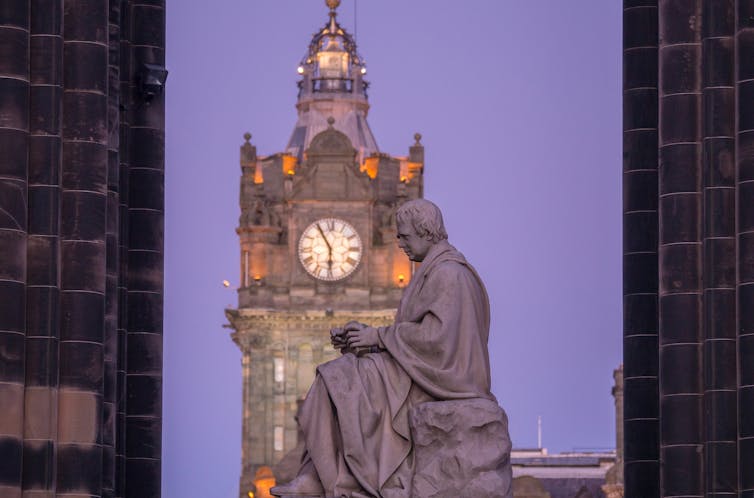
WALTER SCOTT AT 250: SO MUCH MORE THAN A GREAT HISTORICAL NOVELIST


Ulmus Media/Shutterstock


Daniel Cook, University of Dundee

Wander through Edinburgh and you will find glimpses of Scotland’s most famous novelist, Walter Scott, everywhere: pubs named after characters or places in his books, his walking cane and slippers in The Writers’ Museum, and snippets of his work adorning the walkways of Waverley train station – named after his first and most famous novel. And just outside, towering over Princes Street Gardens, his statue stands beneath an elaborate monument affectionately dubbed the “Gothic Rocket”.

Tuesday, 21 January 2020

COLERIDGE'S PERCEPTION OF NATURE & MODERN ECOLOGICAL STUDIES


The modern environmental view of nature holds that nature is a dynamic balance stemmed from a long period of geological and natural evolution between animals and plants, organic substance and inorganic matter, the earth and other planets. It is a physical existence and a vigorous organic substance as well (Xun, 1994, pp.218-219).
Despite of humans’ superior competence and specialties to other species, it does not mean that they have the exclusive privilege to willfully manipulate, enslave, abuse, invade, or deprive the rights of other species to live free.

Thursday, 14 November 2019

WILLIAM WORDSWORTH, MICHAEL

In this video Professors Simon Bainbridge and Sally Bushell discuss Wordsworth’s longer poem, ‘Michael’, first published in the second edition of Lyrical Ballads, 1800.
Professor Bainbridge and Professor Bushell go to a particular site in the Lake District, Greenhead Gill (a gill or ghyll is a mountain stream). This site provides both the setting and inspiration for the poem as well as the place in which it is written. They consider the ways in which Wordsworth builds a sense of place into the poem ‘Michael’.

Tuesday, 17 November 2015

MODULE 2. PARENTS & CHILDREN: MR AND MRS BENNET IN JANE AUSTEN'S PRIDE AND PREJUDICE

Mr and Mrs Bennet - Pride and Prejudice (2005)

Mr. Bennet

Mr. Bennet is the patriarch of the Bennet household—the husband of Mrs. Bennet and the father of Jane, Elizabeth, Lydia, Kitty, and Mary. He is a man driven to exasperation by his ridiculous wife and difficult daughters. He reacts by withdrawing from his family and assuming a detached attitude punctuated by bursts of sarcastic humor. He is closest to Elizabeth because they are the two most intelligent Bennets. Initially, his dry wit and self-possession in the face of his wife’s hysteria make him a sympathetic figure, but, though he remains likable throughout, the reader gradually loses respect for him as it becomes clear that the price of his detachment is considerable. Detached from his family, he is a weak father and, at critical moments, fails his family. In particular, his foolish indulgence of Lydia’s immature behavior nearly leads to general disgrace when she elopes with Wickham. Further, upon her disappearance, he proves largely ineffective. It is left to Mr. Gardiner and Darcy to track Lydia down and rectify the situation. Ultimately, Mr. Bennet would rather withdraw from the world than cope with it.
The 5 Bennet sisters: Jane, Mary, Lydia, Elizabeth, Kitty


Mr Darcy  and Mr Bingley - Pride and Prejudice (2005)
Mrs Bennet
Mrs. Bennet is definitely a comic character. Noisy and foolish, she is a woman consumed by the desire to see her daughters married and seems to care for nothing else in the world. Ironically, her single-minded pursuit of this goal tends to backfire, as her lack of social graces alienates the very people (Darcy and Bingley) whom she tries desperately to attract. Austen uses her continually to highlight the necessity of marriage for young women. Mrs. Bennet

Wednesday, 7 January 2015

LORD BYRON - CHILDE HAROLD'S PILGRIMAGE : ONCE AGAIN UPON THE WATERS


TEXT ANALYSIS : ONCE MORE UPON THE WATERS

Fragments from CHILDE HAROLD’S PILGRIMAGE , Canto III , lines 5-18; 109-117; 127 -144 

 The lines below from Byron’s Childe Harold’s Pilgrimage provide an insight into the wild beauty of Nature and  the Romantic themes of solitude, melancholy and the transcience of life.

LINES 5 -  18
Awaking with a start,
The waters heave around me; and on high
The winds lift up their voices: I depart,
Whither I know not; but the hour’s gone by,
When Albion’s lessening shores could grieve or glad mine eye.
Once more upon the waters! Yet once more!
And the waves bound beneath me as a steed
That knows his rider. Welcome to their roar!
Swift be their guidance, wheresoe’er it lead!
Though the strain’d mast should quiver as a reed,
And the rent canvas fluttering strew the gale,
Still must I on; for I am as a weed,
Flung from the rock, on Ocean’s foam, to sail
Where’er the surge may sweep, or tempest’s breath prevail (... )

Monday, 4 November 2013

REBELLIOUS YOUTH: THE ROMANTICS & LIBERTY


In this BBC documentary Peter Ackroyd,writer, historian and presenter,   reveals how the radical ideas of liberty that inspired the French Revolution opened up a world of possibility for great British writers such as William Blake, Samuel Taylor Coleridge and William Wordsworth, inspiring some of the greatest works of literature in the English language. Their ideas are the foundations of our modern notions of freedom and their words are performed by David Tennant, Dudley Sutton and David Threlfall. 

The Romantics are important because they helped to define, and indeed to create, the modern world. They helped to fashion the way in which we all now think and imagine.

Tuesday, 13 November 2012

THEMES & TOPICS - WAR IN SCOTT'S NOVELS

Just some reflections on how war and fighting are seen in Sir Walter Scott’s novels.


ivanhoeScott has a Romantic idea of war: he presents it as heroic, shaped by the code of romances. According to him the battlefield is a place where every man can practise and show his bravery, his loyalty, his desire to sacrifice himself for other human beings or for a cause. War is the field of the hero and the rebel dissatisfied with society and its unjust rules. War is considered an idealized moment, men fight for some right reasons and for their ideals. 
Scott doesn’t describe the atrocities of killing, he distances the violence of a conflict transforming war into a source of imaginative pleasure, he undercovers the horrors of war with the idea of  future glory. Connected to this conception of war there is the cult of the individual, typical of the Romantic age: a rebel, a hero who fights to defend people unjustly accused, who fights to restore the just lists, against society .