Showing posts with label Robinson Crusoe. Show all posts
Showing posts with label Robinson Crusoe. Show all posts
Friday, 15 May 2020

Tuesday, 21 May 2013
DEFOE VS SWIFT

The two great prose writers of the Age of Queen Anne stand out as representatives of two worlds, of two cultures in conflict: the last of the aristocrats and the herald of the middle class.
Here are just a few hints to reflect on the differences between them
DANIEL DEFOE
|
JONATHAN SWIFT
|
English
|
Irish
|
Liberal ( Whig)
|
Conservative (Tory)
|
Dissenter
|
Anglican
|
Optimistic
|
Pessimistic
|
Exalted the use of reason
|
Satirized the use of reason
|
Championed individualism
|
Condemned individualism
|
Realistic novels
|
Imaginary voyages
|
And now a closer look at SWIFT's GULLIVER'S TRAVELS
SATIRE
Gulliver’s Travels has been considered a satirical masterpiece. But what is SATIRE?
Sunday, 6 May 2012
DEFOE AND SWIFT - A COMPARISON AND OTHER NOTES

LEMUEL GULLIVER - Although Gulliver is a bold adventurer who visits a multitude of strange lands, it is difficult to regard him as truly heroic. Even well before his slide into misanthropy at the end of the book, he simply does not show the stuff of which grand heroes are made. He is not cowardly—on the contrary, he undergoes the unnerving experiences of nearly being devoured by a giant rat, taken captive by pirates, shipwrecked on faraway shores, sexually assaulted by an eleven-year-old girl, and shot in the face with poison arrows. Additionally, the isolation from humanity that he endures for sixteen years must be hard to bear, though Gulliver rarely talks about such matters. Yet despite the courage Gulliver shows throughout his voyages, his character lacks basic greatness. This impression could be due to the fact that he rarely shows his feelings, reveals his soul, or experiences great passions of any sort. But other literary adventurers, like Odysseus in Homer's Odyssey, seem heroic without being particularly open about their emotions. (...)
If you want to continue reading CLICK HERE
Monday, 9 April 2012
THE MYTH OF ROBINSON CRUSOE
1. ROBINSON AS THE SUCCESSFUL SELF- MADE MAN
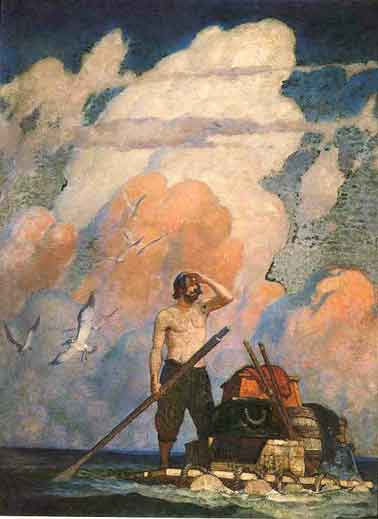 Robinson Crusoe belongs to the tradition of the bildungsroman - German for "formation novel" in that it follows the protagonist development in a period of his life. the novel starts with Robinson as a young man who is supposed to obey and respect his father's ideas but knows that he has to work out his own destiny. He breaks with his middle-class background and pressures of his family to face the unknown both because he feels the appeal of adventures and in the name of economic independence.
According to the critic Ian Watt, Robinson Crusoe exemplifies the homo economicus, the successful self-made man who enjoys and exploits the island where he was shipwrecked:
"Crusoe's island gives him the complete laissez faire which economic man needs to realizes his aims. At home, market conditions, taxation, and problems of the labour supply make it impossible for the individual to control every aspect of productionistribution and exchange. The conclusion is obvious. Follow the call of the wide open places, discover an island that is desert only because it is barren of owners or competitors and there build your personal empire with the help of a man Friday who needs no wages and makes it much easier to support the white man's burden" .
Watt claims for Robinson the title of capitalist:
Tuesday, 3 April 2012
THE 18th CENTURY AND THE RISE OF THE NOVEL
|
| Robinson Crusoe |
These interesting questions are the ones we are going to try to give an answer reading several passages from Daniel Defoe's ROBINSON CRUSOE, Jonathan Swift's GULLIVER'S TRAVELS as well as working in small groups on projects about Tobias Smollet, Henry Fielding, Samuel Richardson and Laurence Sterne.
These are also the questions a celebrated scholar like Ian Watt tried to answer in his well-known essay "The Rise of the Novel". Here's an excerpt from the opening pages:
Subscribe to:
Posts (Atom)