Wednesday, 24 April 2013

A JOURNEY INTO THE HEART OF DARKNESS - JOSEPH CONRAD


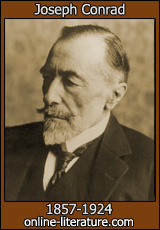
Joseph Conrad
“. . . No, it is impossible; it is impossible to convey the life-sensation of any given epoch of one’s existence—that which makes its truth, its meaning—its subtle and penetrating essence. It is impossible. We live, as we dream—alone. . . .”
These days we are reading some pages from Joseph Conrad's HEART OF DARKNESS (1899) and, as usual, I'll try to help you study and understand both the novel and its author better providing you with useful materials and links.
Let's start with some links to know more about
THE THEMES

NIGHTMARES OF THE CONGO

The story of HEART OF DARKNESS is connected to Conrad's personal experiences. In 1890 he went to Africa to command a vessel on the Congo river for a Belgian company. His predecessor had been killed by native Africans. Conrad was partly there simply to get a living but, at the same time, he was a romantic for whom sailing was a spiritual vocation, as many of his novels testify. However, this time his travelling experience was extremely painful. His four-month adventure left him near death, devastated by fever. In 1891, after his return to Europe, he wrote in a letter to a friend :" I am still plunged in deepest night, and 
my dreams are only nightmares".

Tuesday, 12 March 2013

SOCIAL ISSUES IN VICTORIAN BRITAIN - THE WOMAN QUESTION

"Conventionality is not morality"
(Charlotte Bronte , Preface to the second edition of "Jane Eyre")


Mia Wasikowska as Jane Eyre - 2011

(see also THE WOMAN QUESTION  ppt in the widget box on the right  

We already discussed "The Woman Question" studying Jane Austen's novels. Unfortunately, things hadn't changed in time and Victorian women still had to bear a subordinate social role.
Queen Victoria, "the mother of the nation", personified 19th century middle-class femininity and domesticity perfectly. Supported by her beloved husband Albert and surrounded by her nine children, she presented a kind of femininity which was centred on the family, motherhood and respectability.

Friday, 22 February 2013

ANONYMOUS - WAS SHAKESPEARE A FRAUD?

READ THE ARTICLE + WATCH THE VIDEOS AND ANSWER THE QUESTIONS IN THE WORKSHEET HERE

Scholars and intellectuals have argued the subject for centuries. Was William Shakespeare, the man from Stratford-upon-Avon, the “true” writer who penned the scope of work attributed to him? Or, was the name “Shakespeare” merely a cloaked facade to shield the identity of the works’ authentic author? Have we all been “played”?

Those who believe William Shakespeare did not pen the work are called Anti-Stratfordians; these scholars believe that Shakespeare’s “life doesn’t link up to his work.” They hold that only an aristocrat would have been able to pen such articulate and elevated prose.


Anti-Stratfordian scholars that hold to the “Oxfordian Theory of Shakespeare Authorship” believe that we’ve been “played” by a very talented, stealth Elizabethan courtier named Edward de Vere, the 17th Earl of Oxford. These specific scholars call themselves “Oxfordians.”


Oxfordians maintain that Edward de Vere’s biographical life matches that of the author of Shakespeare’s canon (at least more so than the biography of William Shakespeare of Stratford).


Monday, 4 February 2013

WUTHERING HEIGHTS BY EMILY BRONTE


Emily Bronte was a clergyman’s daughter. She grew up in a remote part of England. She didn’t like to travel. When she left home she became ill. She never married and she died at the age of 30 having published her only novel and some poetry. It was one of the most shocking novel in English literature. When it was first published 1847, it created a firestorm of protest. It was called one of the most repellent book ever published. One critic said it should be burnt. The protest only settle down when the second edition came out and the author was revealed to be the daughter of a parson from west-Yorkshire. How had a parson’s daughter created such a threat to civilized society as Heathcliff, a   hero driven by sexual passion and vengeance and instead of a proper Victorian heroine she gave the world a married woman who runs around on the moor in her nightgown with her lover. The reading public was shocked. Shocked. But the novel has never been out of print and has had many film/ TV adaptations:  WUTHERING HEIGHTS.

Friday, 25 January 2013

HAMLET


Imagine you are a young university student ... Imagine you love Philosophy and Poetry ... You've got friends as well as  a beautiful girl you start fancying about...But your happy ordinary world is suddenly turned upside down by the news of your father's death. You grieve and mourn but you can cope with it...What you really can't stand is ... your mother's behaviour...After just few weeks,  she gets married again, with your uncle, your father's brother...You find it unbearable but nobody else seems to notice that unacceptable exhibition of joy and love. Then something even worse happens: your father's ghost comes back from hell, reveals you the tragic truth of his death and orders you to avenge him! Your uncle Claudius has murdered him and now he is your mother's new husband!

What would you do? Would you respect your father's will? 

This is what happens in the first act of Shakespeare's "Hamlet", one of  the most popular tragedies of all times.

CHARLES DICKENS (1812 - 1870)

Dickens (1812 -1870) was a great prolific writer and entertainer who portrayed a vivid picture of Victorian England. He created a vast range of characters, especially eccentrics, vagabonds, criminals and orphans. In his own life Dickens was extraordinarily popular and he is still the best-known English novelist. He profoundly influenced many of his contemporaries and successors, even abroad (Dostoyevsky and Kafka for instance). Earlier critics tended to regard him as a great comic writer and entertainer, whose plots were implausible and whose characterization was superficial. Contemporary critics now tend to see his works - especially the later ones - as combining social realism with the poetical devices of metaphor and symbolism. These allowed him to explore the depths of the human psyche and to represent social conflict and evil.

If you want to know more about Charles Dickens, download 
the Power Point Presentation from the Widget_Box on the right. 

Tuesday, 15 January 2013

VOICES FROM THE FRONTLINE - FIGHTING FOR HUMAN RIGHTS

Front Line Defenders is the International Foundation for the protection of human rights defenders. They work to provide fast and effective action to help protect human rights defenders at risk so they can continue their work as key agents of social change.

Voices from the Front Line, performed on 9 December 2012 at 8 pm GMT, was a celebration of the courage and determination of human rights defenders around the world.  Voices from the Front Line was hosted by Martin Sheen and featured Andrea Corr, Robert Sheehan & Amy Huberman.


Video 1 . Robert Sheehan reads Liu Xiaobo


WORKSHEET FOR VIDEO 1

Wednesday, 9 January 2013

INTRODUCTION TO THE VICTORIAN AGE - POWER POINT PRESENTATION

Queen Victoria's family in 1846 by Franz Xaver Winterhalter
You can download the

 POWER POINT PRESENTATION,   THE VICTORIAN AGE
  (HISTORICAL/SOCIAL/CULTURAL BACKGROUND )
from the Flash_ Widget Box on the right sidebar (The Victorian Age 2011)


Wednesday, 2 January 2013

BEOWULF, GRENDEL AND THE DRAGON - NOTES AND ACTIVITIES BASED ON VIDEOS

The epic poem


The word “epic” come from the Greek noun épos, which means “the poets’ oral exposition”. The two major epic poems in the Western tradition are The Iliad and The Odyssey, attributed to the Greek poet Homer. Later examples of epic poems are Virgil’s Aeneid and the Anglo-Saxon Beowulf.


  •  The main features of an epic poem are:
  •   Long narrative
  •   Elevated style
  •  Celebration of the deeds of a hero
  •  Presence of supernatural events and characters
  •   Description of an aristocratic, military society
  • Typical scenes: the banquet, the battle, the voyage, the funeral

Beowulf 


It is a poem of 3, 182 lines. It is the longest surviving poem in Old English, the name given to the language of the Anglo-Saxons. It is also the first important example of poetry in a European language that is not Latin or Greek.
There are a couple of references in Beowulf to historical events in Denmark from the 6th century, but almost all the poem is based on legends, not history.
The version of the poem we have now was probably composed between 700 and 750. It was composed in England, but the story takes place in Sweden and Denmark. This means the Anglo-Saxons went on telling traditional stories from the Germanic world even after they had invaded England.

Like other early poetry in other cultures, Beowulf was first transmitted orally, for centuries, before finally being written down. In Anglo-Saxon times only very few people could read or write, and there were very few books, which all had to be written by hand. Printing books in Europe was only invented in the 15th century.

Thursday, 6 December 2012

READING, WATCHING, DISCUSSING JANE AUSTEN'S EMMA


Emma was written between January 1814 and March 1815. The setting of the narrative's action would appear to be recent: 1813-14. By this period, Austen was a known and successful writer. Like Sense and Sensibility, the work was published on commission by the distinguished house of John Murray. It was published ('by the author of Pride and Prejudice, etc.') in December 1815 (dated 1816 on the title page). The novel was dedicated to the Prince Regent, at the request of the Carlton House Librarian, the Revd James Stanier Clarke.

When , in January 1815, Jane Austen began to write her fifth novel, EMMA, she stated that she was working at creating a heroine that nobody but herself would be able to like ("I am going to take a heroine whom no-one but myself will much like.")

The Heroine
Emma Woodhouse is beautiful, clever and wealthy (the only Austen heroine to own all these “virtues”) but also spoilt and a bit snob. Readers, especially Austen’s contemporary readers, shouldn’t like her much since Emma definitely lacks the common sense, balance and measure of other heroines. Yet, even with her faults and her mistakes, the character of Emma is drawn to get sympathy and understanding; the reader tends to forgive her and to side with her in a totally irrational way. Emma’s defects, constantly underlined in the text, make her the perfect anti-heroine: she is not particularly accomplished, she has been educated by too an indulgent father and too a friendly governess, she has great self-esteem and tends to misinterpret reality according to her wishes. In a few words, she is not “by the book”, if we think of the 18th century “conduct - books” about the education of girls belonging to high society. But , of course, Jane Austen, is mocking those clichés, so her Emma is not only beautiful and intelligent but , above all, free. It is Mr Knightley himself to acknowledge that Emma is perfect with all her imperfections. 

Monday, 3 December 2012

SHAKESPEARE'S RICHARD III IN MOVIES - VIDEO COMPARISON


While historians and historical fiction writers have re-discovered and re-written what people for centuries have thought of Richard III, the only image we have on stage and in films is the one we inherited from Shakespeare.
"The history of the world, like letters without poetry, flowers without perfume, or thought without imagination, would be a dry matter indeed without its legends, and many of these, though scorned by proof a hundred times, seem worth preserving for their own familiar sakes". (from the preamble of Richard III 1955)
On Imdb you can find a detailed list of all the filmed works dedicated to or  focusing on Richard III,  and including even those movies just featuring him as a minor character. But, except for The Black Arrow (adaptation of R. L. Stevenson's historical novel in which young Richard of Gloucester helps the protagonist Richard - Dick - Shelton), in all of them we have him portrayed as the wicked villain. 

Monday, 26 November 2012

SAMUEL TAYLOR COLERIDGE & THE RIME OF THE ANCIENT MARINER


 DOWNLOAD THE POWER POINT PRESENTATION 

S.T.COLERIDGE AND THE RIME OF THE ANCIENT MARINER  

from the widget_box on the right 

LINKS & CONNECTIONS

  If you like heavy metal, IRON MAIDEN made a rock version of Coleridge's ballad

Video: IRON MAIDEN THE RIME OF THE ANCIENT MARINER PART 


Lyrics  


Tuesday, 20 November 2012

WILLIAM WORDSWORTH


WILLIAM WORDSWORTH
  • Preface to "Lyrical Ballads" - The Manifesto of English Romanticism (1800)
  • everyday situations as the subject of poetry
  • use of the language of common people purified by the poet
  • recollection in tranquillity
  • the poet is a man speaking to men but with a greater sensitivity

Thursday, 15 November 2012

WAS RICHARD III REALLY THE VILLAIN SHAKESPEARE PORTRAYS?

Was Richard III really the scheming, villanous tyrant Shakespeare so powerfully  depicted in his tragedy? 
The Richard III Society, believes it untrue. They state: 


 "… the purpose and indeed the strength of the Richard III Society derive from the belief that the truth is more powerful than lies - a faith that even after all these centuries the truth is important. It is proof of our sense of civilised values that something as esoteric and as fragile as reputation is worth campaigning for." 

What they reject is the portrait Shakespeare drew from Sir Thomas More's biography of the last Plantagenet kings, Edward IV first, his younger brother Richard III then.

What was the full Thomas More treatment, that still seems to be current in some quarters?  Let us look at the dossier that has been built up against Richard III:

Tuesday, 13 November 2012

THEMES & TOPICS - WAR IN SCOTT'S NOVELS

Just some reflections on how war and fighting are seen in Sir Walter Scott’s novels.


ivanhoeScott has a Romantic idea of war: he presents it as heroic, shaped by the code of romances. According to him the battlefield is a place where every man can practise and show his bravery, his loyalty, his desire to sacrifice himself for other human beings or for a cause. War is the field of the hero and the rebel dissatisfied with society and its unjust rules. War is considered an idealized moment, men fight for some right reasons and for their ideals. 
Scott doesn’t describe the atrocities of killing, he distances the violence of a conflict transforming war into a source of imaginative pleasure, he undercovers the horrors of war with the idea of  future glory. Connected to this conception of war there is the cult of the individual, typical of the Romantic age: a rebel, a hero who fights to defend people unjustly accused, who fights to restore the just lists, against society .

Monday, 5 November 2012

WAVERLEY & IVANHOE: TWO ROMANTIC HEROES

WAVERLEY (1814)
PLOT

•       Edward Waverley is educated in an English Jacobite aristocratic family.

•       He is sent to Scotland to join the Hanoverian army of king George II.

•       He visits a Jacobite family friend, whose daughter, Rose, falls in love with him.

•       He , instead, is attracted by Flora Mac Ivor, the sister of the chief of the      rebels, Fergus.

•       Edward betrays his mates and joins the rebels.

•       He is finally forgiven by the king and marries Rose.

•       Fergus is killed and Flora retires into a convent.

HISTORICAL CONTEXT
Waverley is set during the period of the Jacobite uprisings: it starts in the late summer of 1744 and ends many months after the battle of Culloden (1746) when the Jacobites were defeated and their cause was virtually destroyed.

Wednesday, 24 October 2012

MY STUDENTS GIVE THEIR LESSONS : THE PICTURE OF DORIAN GRAY

Giulia, Nico e Sara closed the series of lessons my 5scB students gave to the rest of the class after reading a 19th century novel of their choice during summer. This morning it was the turn of Oscar Wilde's The Picture of Dorian Gray. The three students in the group used pictures and Power Point slides to visually support their very informative speech about the author, the characters, the story and the themes in the novel.
Since we are not working on the Victorian Age yet, they didn't try to contextualize Oscar Wilde's work. They instead made very interesting points analysing the themes .
While listening, their mates took notes. I sadly noticed that some of them were rather "surprised" at discovering  Oscar Wilde's troubles and tragic end due to his homosexuality. The mentioned some were rather judgemental and, I'm afraid,  I can't bear that. Unfortunately,  in my experience, young people are sometimes much less tolerant and less understanding than adults. I must work on that. Promise.
(The power point presentation used in this lesson is in the widget_box on the right - Dorian Gray 2012)


Tuesday, 16 October 2012

MY STUDENTS GIVE THEIR LESSONS: JANE EYRE

Federica, Valeria e Veronica read Charlotte Bronte's Jane Eyre in the summer and prepared a very interesting lesson  about the author and the novel.

They presented their points and analysis with power point slides that you can download from the widget_box on the right (Jane Eyre 2012) and they also proposed us a scene from the latest movie adaptation of the story with Michael Fassbender as Mr Rochester and Mia Wasikowska as Jane Eyre. 

They said they liked reading this novel  and I hope they will also like studying Victorian literature from January on.

For now, in our lessons,  we are working on the different genres of fiction between the end of 18th century and the beginning of the 19th century (Mary Shelley, Jane Austen, Walter Scott)

Tomorrow we'll work on Pride and Prejudice. "It is a truth universally acknowledged that ..." a teacher fond of Jane Austen, Charlotte Bronte and great classic literature is having and will have great fun.

 Will her students ever share her passion?

Friday, 12 October 2012

MY STUDENTS GIVE THEIR LESSONS: PERSUASION BY JANE AUSTEN

The book Elena, Eleonora, Elisabetta, Emi e Valentina read last summer was Persuasion  so they prepared their lesson on Jane Austen's last novel , introducing also The Novel of Manners as a genre . They carefully chose information, videos and pictures to report to the rest of the class with the help of a power point presentation.

They carefully analysed the characters and the themes in the story, proposed their favourite scenes from the 2007 adaptation of the book and introduced to their mates the woman question referring to authors like Mary Wollstonecraft and Margaret Fuller to finally discuss the fact if Jane Austen can be considered a feminist writer.

 You'll find their work in a folder in the widget_box on the right sidebar. 

Thursday, 11 October 2012

PRIDE AND PREJUDICE - PART II


In Pride and Prejudice Part I we stopped at the the unexpected turning point that is Mr Darcy's marriage proposal to Elizabeth Bennet. 

1. What happened? 
2. How did Elizabeth react? Why?
3. Did Mr Darcy expect her refusal? 

Sunday, 7 October 2012

JANE AUSTEN & THE NOVEL OF MANNERS: PRIDE AND PREJUDICE - PART I


“It is a truth universally acknowledged, that a single man in possession of a good fortune, must be in want of a
wife”.
This is the widely popular sentence opening the widely popular story of the five Bennet sisters  written by Jane Austen between October 1796 and August 1797. Its original title was FIRST IMPRESSIONS but it was published only in 1813 with the title, PRIDE AND PREJUDICE.
The opening scene is set in Hertfordshire, a county that nowadays has practically become part of Greater London, as suburban development stretches even further northwards. In the late 18th century, however, it was still well-wooded countryside.
The story opens early in September, when Jane Austen takes us straight into Longbourn House to listen to the Bennets’ conversation after dinner. Mrs Bennet is making plans for husband –hunting on her daughters’ behalf. Five daughters and an estate worth £2,000 a year were not an easy situation to cope with, especially if your husband (Mr Bennet) is not very good at saving. The urgent need for husbands is also due to the fact that the estate of Longbourn is “entailed” – a legal arrangement whereby the property could descend only to a male heir.

Friday, 28 September 2012

THE GOTHIC NOVEL - NOTES & POWER POINT PRESENTATION


THE SUBLIME

The term refers to a linguistic, literary or artistic form which expresses noble or elevated feelings and behaviour. The concept of sublime was analysed by an unknown rhetorician of the 1st century AD who identified  the sublime with the beautiful and found its origin not in the perfection of style but in the passion of inspiration echoing in the soul .